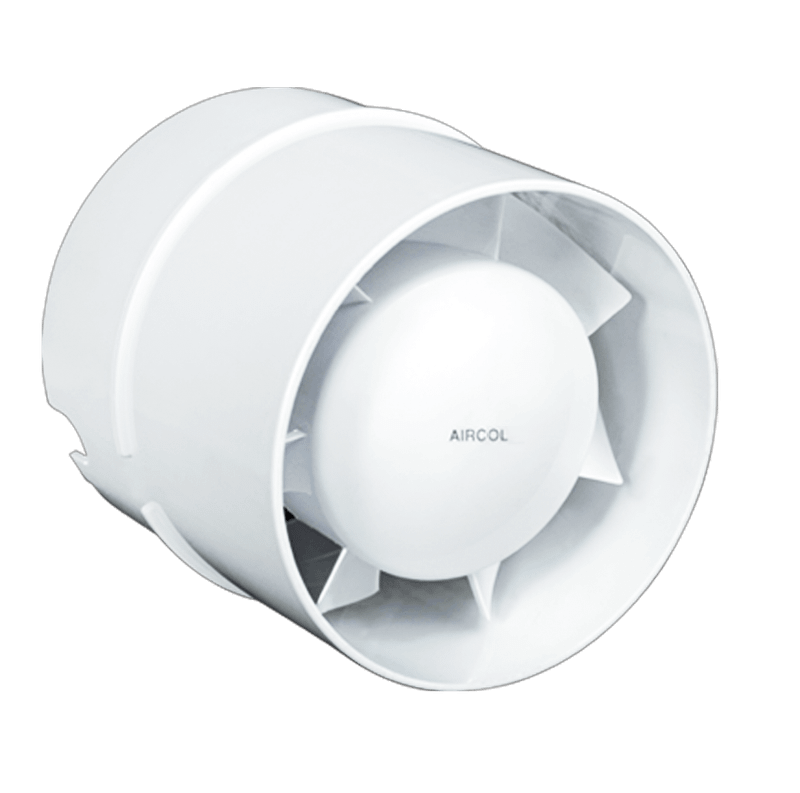
Aircol 100 KT Round Duct Fan/Exhaust Fan, 100 mm, 100 m³/h
$13.06 $14.51 · In stock
Brand: Aircol · SKU: Aircol-100-KT · Warranty: 24 months
Other options
Product description
Applications
- For small and medium-sized spaces:
- Suitable for ventilating bathrooms, toilets, kitchens, residences, offices, workplaces, pantries, garages, and similar spaces.
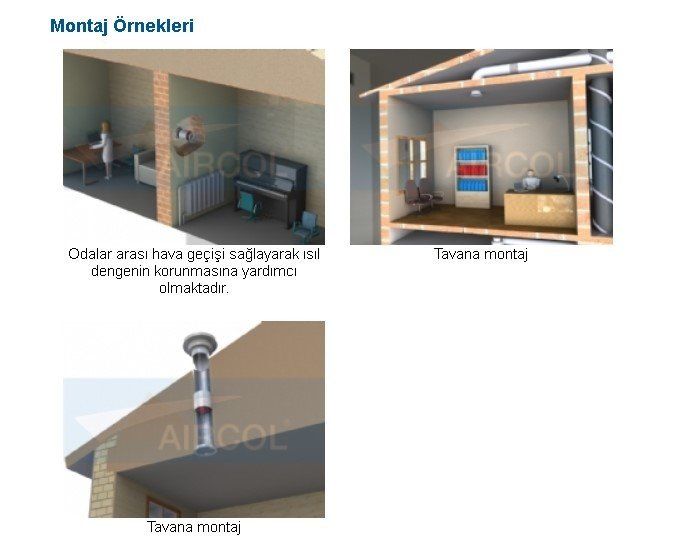
- Designed specifically for in-duct ventilation applications and for providing air flow between rooms.
Features
- Designed to discharge air directly to the outside or through a short duct. The duct to be used must be straight and shorter than 1.5 m.
- Intended to facilitate small to medium volume air movement against low static pressure.
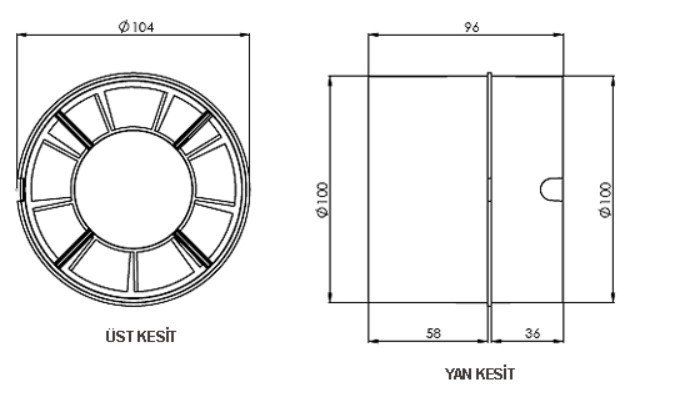
- Can be used easily in flexible or rigid ducts.
- Manufactured from high-quality ABS plastic, our product provides the best protection against bad odors, moisture, and similar external factors while never losing its original appearance.
- The optimized fan design minimizes noise levels while providing high-pressure air extraction.
- Can be easily connected to walls, ceilings, windows, and the inside of ducts.
- Self-lubricating, maintenance-free motor bearings provide quiet and long-lasting performance.
- Has IPX2 protection against water splashing.
- It has Class II protection that requires no earth connection.
- Our products are manufactured in accordance with EN 60335-2-80, Low Voltage Equipment [2006/95/EC] and Electromagnetic Compatibility [2004/108/EC] standards.
| Voltage/Frequency | (Volt/Hz) | 230/50 |
| Current | (A) | 0.10 |
| Power | (Watts) | 12 |
| Flow Rate | (m³/h) | 100 |
| Speed | (Rpm) | 2200 |
| Pressure | (Pa) | 24 |
| Noise Level (@3 m) | (dB (A)) | 30 |
| Min. / Max. Ambient Temperature | (°C) | -30 / 40 |
| Weight | (Kg) | 0.4 |
| Material | ABS plastic | |
| Protection Class / IP | II / IPX4 | |
| Motor Insulation Class | B |
What to Consider When Selecting a Radial Fan
4 parameters should be considered when selecting a fan:- Required air flow rate
- Pressure losses
- Acceptable Noise Level
- Electrical Power Connection Type
| Environment | Air Change Coefficient |
| Classrooms | 5-7 |
| Libraries | 4-5 |
| Domestic kitchens | 15-25 |
| Bathrooms | 5-7 |
| Domestic restrooms | 4-5 |
| Public restrooms | 8-15 |
| Conference rooms | 6-8 |
| Offices | 4-8 |
| Changing rooms | 6-8 |
The amount of air per person in living and working spaces, depending on activity, can help determine the required air flow rate.
| Normal Activity (Non-Smoking) | 29 m³/h |
| Normal Activity (With Smoking) | 58 m³/h |
| Light Activity | 45 m³/h |
| Heavy Activity | 60 m³/h |
Based on the information provided above, the required air flow rate is determined as follows.
- Q [ m³/h ] = Air change rate coefficient (1 hour) × Space volume (m³)
Or
- Q [ m³/h ] = Number of people × Air flow rate required per person
Fan selection is made according to this flow rate requirement.
After completing the flow rate calculations, the installation location of the fan must be determined. Where will the fan be mounted — on the ceiling, wall, chimney or ventilation duct? Another consideration is the voltage of the electrical supply to the fan. Since we are using an office as our example, let's continue from there. Fans are generally mounted on walls or windows in offices. If domestic electricity is to be used, a single-phase fan should be preferred. If the fan is to be used in an industrial setting, a fan operating on three-phase (380 V) power should be used.Specifications
| Brand | Aircol |
|---|
Similar products
- Modern Teknik Axial Chimney and Wall Exhaust Fan, 25 cm, 220V, 1,500 RPM, 1,500 m³/h – $203.76
- Nano Water Filter, 1 Inch – $171.69
- Fansan Decorative White Bathroom and Toilet Glass and Window Ventilation Fan – $10.62
- Aircol 20 K Shuttered Axial Fan / Extractor, 360 m³/h – $34.03
- Modern Teknik 0.5 HP Low-Pressure Open-Blade Centrifugal Fan, 45 mmWG, 2,000 m³/h – $485.23
- Aircol 100 mm Duct Inline Round Fan 390 m³/h 2300 rpm - Aircol 100 KF – $48.17
- Raksan Smart ABS Plastic Marine Anemostaat, 100 mm – $4.61
- Dündar MF 280 Axial Fan (EBMPAPST W2E250-HL06-01 Compatible), 280x280x85 mm, 230 V – $94.17
- 65 cm Industrial Pedestal Fan 65 cm – $111.75
- Aircol 150C MP Glass and Wall-Mount Axial Fan – $31.84
More products in Bathroom and Toilet Exhaust Fans · All Aircol products